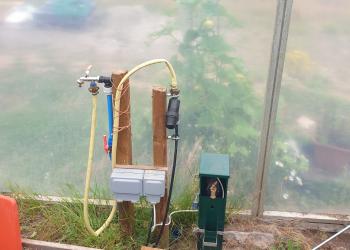
Achieving water security on site, so in times of drought there is less dependence on mains water for growing food. Also, increasing our capacity for raising healthy seedlings contributing towards the garden’s productivity. In turn, improving the supply of fresh, locally produced, chemical-free vegetables to the Dundee community.

Campy Growers
Go To WebsiteAddressed Challenges:
- Health and Wellbeing
- Food Security and Supply
- Carbon Emissions
- Flooding and Drought
- Tech and Innovation
Action Areas:
- Land Use, Food and Agriculture
- Energy
- Transport
Initiative Purpose:
- Mitigation and Adaptation
The Story
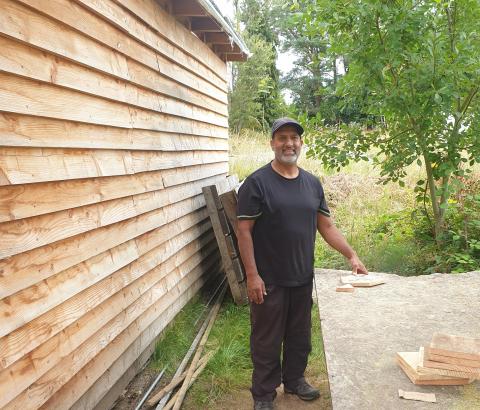
Our project aimed to make Dundee’s largest community garden a more productive, environmentally resilient growing space with stronger links to the community.
What has this meant?
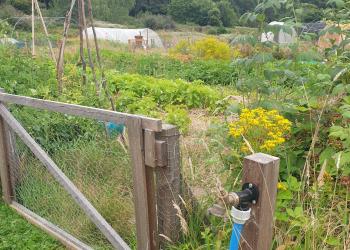
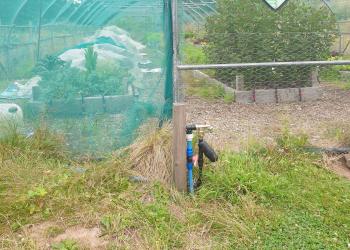
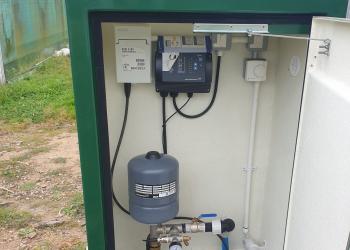
The Dundee Climate Fund has enabled us to install a borehole in order to be largely self-sufficient in water to irrigate our vegetables. With a drilling rig on site for two days, a contractor was able to drill down into an aquifer 60m below the surface. A pump was then installed, and linked to two thirds of our site through digging-in a network of pipes and taps, and now we are able to water our vegetable via drip lines, sprinklers and hand-watering where we need to. In addition we have purchased a rainwater tank that will enable us to harvest rainwater from the roof of our community hub and irrigate a growing space in -the-making outside of our building. This is linked to a co-design exercise for a new growing space outside our community hub.
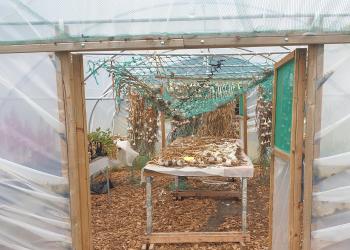
Using the fund we have also built a small propagation tunnel about 4.5m by 15m, built by a staff member. The tunnel is split into two halves: one half is a polytunnel covered in plastic with three benches sat length-ways on which we sit our seed trays. The tunnel offers shelter from the wind and provides a warmer environment in which we can bring on veg more quickly. And the second half of the tunnel is under netting to protect seedlings from butterflies and birds. Whilst we need to build in a little more wind protection, it offers a protected space to ‘harden off’ our seedlings prior to them being planted out. Having both facilities next to one-other makes us more time-efficient.
We have been able to employ a handy-person / delivery driver for 12 hours in the week. Using an electric van purchased through a Climate Choices partner, Alexander Community Development (ACD), we were able to deliver 10 veg boxes / week across Dundee on a Friday morning. The veg boxes were part of scheme called Community Supported Agriculture that connects growing spaces to their customer communities, creating opportunities to connect people more closely with the local growing spaces and the challenges of growing food without chemicals.
Our handyman has also offered the garden the dedicated time and expertise to improve our growing space significantly. In practice this has meant: building cold-frame lids to keep the late winter / early spring chill off our seedlings; install fencing to keep rabbits off another of our growing spaces; replace polytunnel curtains saving us £1000s in contractor fees; begin improving access to our tunnels; install rodent proof mesh around 180m of polytunnel skirting to protect our indoor crops; carry out substantial repairs to our polytunnel beds; install irrigation and irrigation infrastructure, replace tunnel netting and more….
And finally….with e-Cargo bike insurance we have been able to use an e-cargo bike offered to us through the Dundee Cycle Hub and take our vegetables out to community venues in surrounding areas like the Charleston Food larder, improving the visibility of our fresh, healthy vegetables, and opportunities for volunteering at Campy Growers with the physical and mental well-being that offers.
Success & Outcomes
In terms of quantitative successful outcomes we were able to produce and distribute 474.84kg of vegetables - this was double the amount of our target! Also, we were able to give away 250 seedlings to several Dundee community gardens as well as a school, new allotment owners and others. We continued our Saturday veg stall in Camperdown Park and the fresh produce delivery made by Alexander Community Development. Ultimately, we were able to irrigate a greater growing area, reduce labour input and improve crop reliability which was a huge success.
Advice for others looking to do something similar
There is a theory that if you have a vision (and it has some kind of foundation, but without certainty), why not go for it. Things can fall into place. That is our experience with the borehole; whilst a borehole had been sunk nearby there was no certainty we would find water. Things fitted into place. The Climate Fund was a big part in realising that vision.
Some of our project was about managing suppliers / contractors. We learnt the following:
- When dealing with a company, try to get a generic email address as well as a named individual so that contact can be restored if that person moves on.
- When planning and managing the project, try to ensure you have more than one (preferably three) people in your organisation who are ‘in the loop’ i.e. ccd into emails and attending onsite meetings. This builds in redundancy should anyone from your organisation leave and a second person’s perspective on verbal discussions can reduce confusion.
- If you ever come across trades people who might be useful in the future, take their number! You may need plumbers, sparkies and digger drivers for jobs such as this. Roofers and carpenters are useful people too. Double up.
- Likewise any experts you might come across such as architects, water engineers, geologists etc.
- Do everything you possibly can yourself and as quickly as possible – you never know when a coincidence or chance encounter might allow the next stage to be completed.
- Keep an eye out for ‘free stuff’ and acquire it asap as someone else might do the same.
If you have the capacity and a little expertise, it is great to be able to do work yourselves if you can. It is very empowering and builds capacity. Our 40m long polytunnels were fitted with curtains made from poor quality plastic. After two years they had split. We had a quote from a contractor to do the work which came to around £3000, a figure we could not afford. Our handyman, paid for by DCF, was able to do the job for us.
The Climate Fund has enabled us to think ahead (beyond our immediate day-to-day) and invest in a climate resilient infrastructure that we would not have been able to access / afford otherwise. We have been able (we hope) to future-proof our growing space for a climate-uncertain future.